
Hot-dip galvanizing as a method of corrosion protection
Every year, 10% of steel is lost in the corrosion process. Because of this, the issue of protecting metal products from environmental influences is relevant. Hot-dip galvanizing is an advanced method that allows you to protect finished metal and steel structures from atmospheric, water and soil corrosion. Zinc has been used as a material for corrosion protection for over 150 years. Millions of tons of zinc are produced worldwide every year. Half of this volume is used to protect steel from rust. Other metals are also used for anti-corrosion protection, including magnesium, aluminum, and cadmium. An environmentally attractive aspect of using zinc is that 80% of it is reused and it does not lose its physical and chemical properties. By protecting steel, zinc helps to preserve natural resources.
Coating of steel occurs when a metal product is immersed in molten zinc (melt temperature 440-460 °C). During galvanizing, both the outer and inner surfaces of the parts are coated. The coating thickness is 60-100 microns (depending on the thickness and chemical composition of the steel from which the product is made). The zinc coating is a barrier that protects the surface from environmental influences. However, in addition to the barrier, zinc also provides electrochemical protection, since a galvanic cell is formed when it comes into contact with iron. The voltage that arises in the cell, even if the zinc coating is damaged, leads to corrosion of zinc, not steel. Other anti-corrosion systems create either a protective barrier or a galvanic cell. Only hot-dip galvanizing combines these two methods into one, creating an effective method that protects steel for many years. The service life of galvanized metal is from 20 to 65 years, depending on the thickness of the coating and the aggressiveness of the environment.
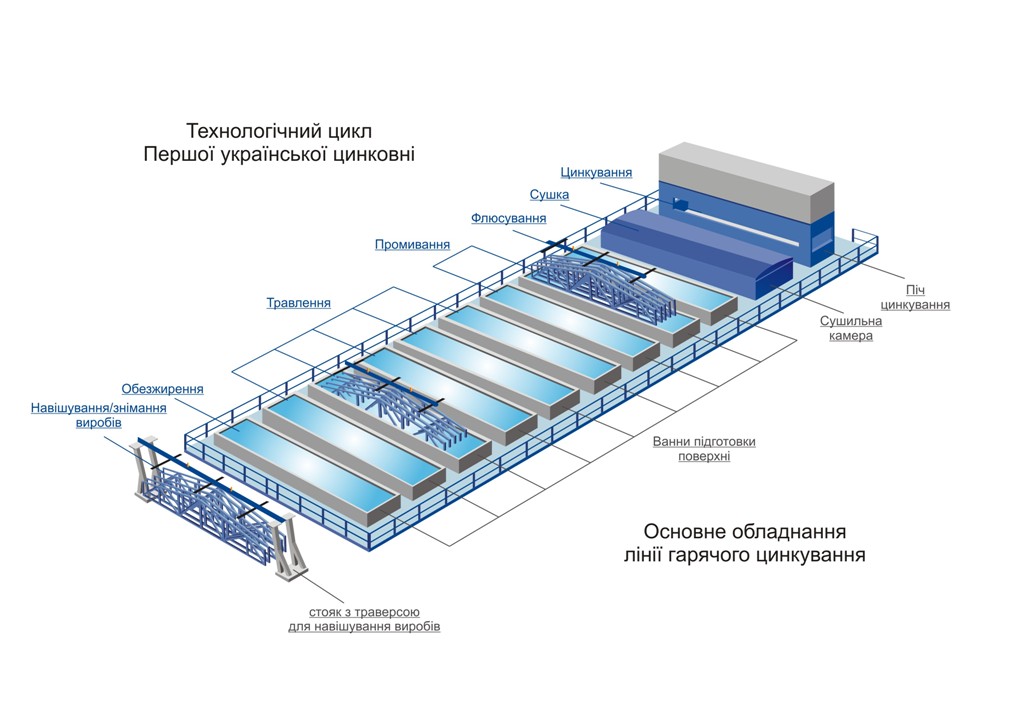
Technology
The technological process consists of 6 stages:
- Degreasing – at this stage, grease stains, preservative oils, and other synthetic layers that hinder and slow down the etching process are removed from the surface of metal products and structures.
- Pickling is an important stage in the preparation of the surface of metal products for galvanizing. During pickling, rust is removed from the surface of parts, as well as chemical activation of the steel surface (removal of the oxide film) without damaging the main surface.
- Rinsing – during rinsing, etching products are washed off the surface of products being prepared for galvanizing.
- Fluxing is the final stage of surface preparation, which is necessary to apply a layer of salts to the surface, which ensures optimal adhesion. In addition, the flux layer performs a protective function.
- Drying – during the drying process, the flux salts dry out. The products are heated to 100 ºС.
- Galvanizing is the process of forming a zinc coating due to the reaction between iron and molten zinc, as a result of immersing the prepared product in the melt.
Each of these processes takes place in special baths.
Estimated service life of the zinc coating until the first repair depending on the environmental category, risk and degree of corrosion according to UNI EN ISO 14713 standards
| Code | Corrosion category | Risk of corrosion | Degree of corrosionAverage zinc thickness loss rateμm/year |
|---|---|---|---|
| C1 | Internal conditions: dry | Very low | ≤ 0.1 |
| C2 | Internal conditions: rare condensationExternal conditions: open inland agricultural areas, remote from the sea | Low | from 0.1 to 0.7 |
| C3 | Indoor conditions: high humidity, partial air pollutionExternal conditions: inner city areas or areas moderately remote from the coast | Average | from 0.7 to 2 |
| C4 | Indoor conditions: swimming pools, chemical plants, etc.External conditions: inland industrial areas or coastal areas of cities | High | From 2 to 4 |
| C5 | External conditions: industrial areas with high humidity or coastal areas with high salt content in the air | Very high | From 4 to 8 |
| lm2 | Seawater in temperate climates | Very high | from 10 to 20 |
The hot-dip galvanizing service includes:
- Unloading and loading the vehicle (products must be on pallets or pads for quick unloading by a crane or forklift);
- Chemical preparation of the product surface;
- Zinc coating according to ISO 1461:2022;
- Cleaning of products after the hot-dip galvanizing process.